
Get Some Vitamin D(ata)
Tracking metrics might be good for me.


“Why is the humidity sensor fucked again?!”
The read out on my humidity controller stuck at 100% for days. I figured it was a dud, I had just replaced it after all.
The thing is that it kept happening. I would spend 30 minutes setting up my station, carefully cutting away electrical insulation, soldering a new sensor on, then sealing it back up. Sure enough, that too would go to 100% and stay there.
The problem with that is:
I don’t get an accurate representation of the climate
The control, thinking the room is saturated, does not turn the humidifier on. The result: the grow room becomes bone dry.
Not cool.
I had been using inexpensive Inkbird humidity controllers for years, and for the most part, they did a really good job. But when they failed, it would take out my entire grow room. Sometimes, it would happen when I thought I could take a day or two away from the shop.
For over a year, I had replaced the humidity controller with a cycle timer. This would let me set the ON and OFF time for my humidifier. 4 minutes on, 5 minutes off for example. I could make small adjustments as necessary. This seemed to work well enough.
A while back, I started building out a monitoring and control system for my mushroom facility. Like most good things, it took a lot longer to set up than I estimated, but it started paying off almost immediately. I first implemented the sensor while I still had the humidifier on the cycle timer. I realized that I was running my grow room WAY to humid. It seemed like it was fine, but the readout was too high. I dropped it down and lo, the quality of the mushroom improved within the week.
Once I hooked it up to the humidifier, I was able to both get the data and control the humidity output. Every once in a while though, the old problem would return: The humidity would max out, drying out the grow room.
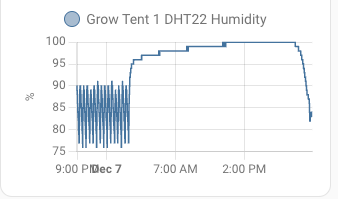
Now I can see it happened at a specific moment in time. Maybe I could play detective. What was the temperature doing?
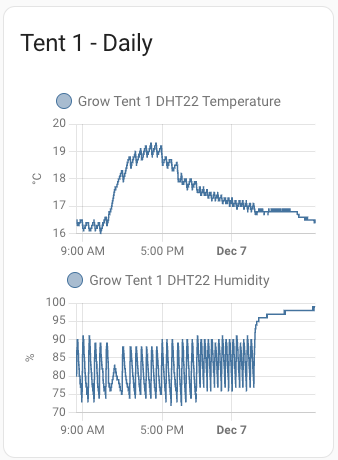
Hmmm…. Right when the humidity when up, the temperature had dropped to ~16.7C.
As air gets cooler, it can hold less humidity. At some point, the air can’t hold the humidity anymore and it condenses. This is what the dew is on your lawn in the morning. It gets cool at night and the air can’t hold all that water anymore.
Huzzah!
I went into the control system and updated the code to preemptively decrease the humidity as the temperature drops, well before the dew point. Since then, I haven’t run into this issue.
It took me over 10 years of growing mushrooms to finally learn this. Learning this years ago would have saved me so much time, money and energy but alas, here we are.
It does, however, make me want to measure and collect as much data as possible about Heartwood’s operation. With good data, I’ll be able to make better decisions. Otherwise, I’m flying blind.
I’m going to continue to build out the monitoring system for the shop. On top of that, we are going to start manually tracking data about all stages of production, contamination rates, cleaning intervals, order and fulfillment times and overlaying that with revenue.
The truth is, I haven’t known my numbers. I feel embarrassed writing that, having been working on this business for 7+ years now. It took exactly as many 2x4’s to the head as it was necessary for me to learn how important measuring is.
I’ve been investing heavily into Heartwood’s equipment and infrastructure. That phase seems to be coming to an end, a few bits and bobs left. The next chapter will be data-driven, learning how to actually run this machine.
Way to figure it out! But meanwhile you've learned a lot of other stuff along the way too.