Growing a Scientist
From Frozen Fish Sticks to Flow State

One morning when I was four, I waited patiently until my mom took a moment to close her eyes and lie down on the couch.
This was my moment.
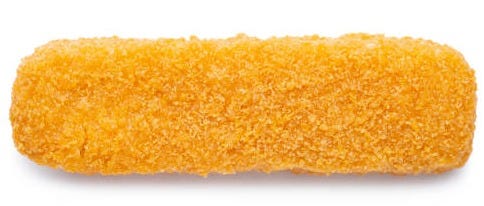
I dragged a heavy dining chair across the kitchen, climbed up, and liberated a single frozen fish stick from the box in the freezer. Chair back in place, I crawled under the table and gnawed at my prize in secret. It wasn’t great (cold breading is an acquired taste) but I scraped it off with my teeth until only a pale, slightly soggy slab remained. Right on cue, Mom appeared.
If I’d had words to articulate back then, I might have said:
“Sometimes you say no to things I want, and I don’t like that. It’s 10 a.m. and I want fish sticks. Since you usually veto early fish sticks, I figured it was simpler not to ask.”
Clearly, I was still learning how the world worked.
I love questioning, testing, and seeking to understand my limits, and the world around me.
Electricity fascinated me endlessly. It delivered Saturday morning cartoons. It carried Kim Mitchell’s flanged guitar in “Go For a Soda,” and the heart-tugging harmonica in Sting’s “Fields of Gold.” It turned my mom’s oil diffuser into calm, lavendered air.
This invisible force flowed like a current through every favourite moment.
Well, mostly invisible, until a thunderstorm cracked open the sky, shook the windows in their frame, and made my heart skip. That, too apparently, was electricity. Incredible!
I’d press my face to the window screen, breathing in petrichor laced with the sharp metallic tang of mesh, warm rain pattering my waffled cheek and nose, waiting for lightning to flash overhead to try and see it.
But electricity’ greatest power? It cooked fish sticks.
I needed to understand how.
Through thorough surveys and questions, my parents taught me that electricity was dangerous: never stick anything in the wall sockets. Respect for danger kept my fingers and forks out.
But questions only took me so far. Real understanding required experiments.
Baking-soda-and-vinegar rockets were excellent for learning basic chemistry: fold baking soda into tissue, drop into film canister, add vinegar, snap lid, flip, run.
POP!
Construction-paper rocket fins and nose cone optional but recommended.
Other experiments were less appreciated.
I needed to know how the VCR worked. A cassette with dinosaurs on the cover when pushed into the video player showed dinosaurs on on the screen. Merlin and Arthur on the case? Merlin and Arthur on the TV. It was a clear pattern. But why? and to what end?
Would putting Hot Wheels cars, chalk, or Lego into the VHS slot produce corresponding images? Would I see my own eyes looking back at me through the open slot on the TV as through a camera was capturing everything that went in?
It did not.
It did, however, start producing alarming grinding and whirring noises and that temporarily paused our movie nights.
Some mornings brought fresh opportunity to run tests. Mom was resting on the couch again.
Go time.
Purpose of today’s experiment:
Unlock the electrical secrets of the toaster.
Achieve hot, crispy fish sticks.
Advance human knowledge.
Equipment
Toaster
Cup
Faucet
Outlet
Hypothesis
Bill Nye taught me water conducts electricity, that it acts like a bridge.
So, does that mean that more water = better electricity flow = better fish sticks?
Only one way to find out.
Procedure
Unplug toaster (safety first)
Fill cup with tap water
Pour equal amounts into both bread slots
Lower lever
Repeat steps 2-4 until I learn something
Observations
Nothing dramatic. Just brown, crummy water leaking everywhere, soaking my pants and the floor.
Mom walked in on me, perched on the counter, solemnly dumping cup after cup into the toaster, pressing the lever with determination, while dirty water cascaded off the edge.
I can imagine now what was going through her mind and the mess was probably secondary.
Discussion and Analysis
I hated getting in trouble, but science demanded risk. While I braced to get reamed out, Mom stayed gentle. She noted, impressed, that unplugging the toaster had been exceptionally smart.
Nice. Gold star for me.
She also offered a new deal: any future experiments, just ask her first. She’d help make them better and easier.
And to me, that sounded like the opposite of “no.”
Sign me up.
Conclusion
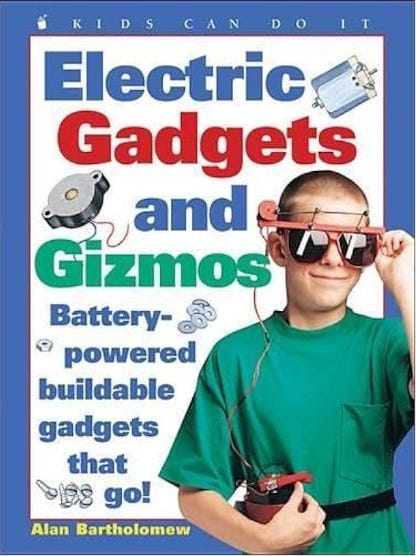
Soon afterward, I received the coolest gift ever: Electric Gadgets and Gizmos by Alan Bartholomew. It was a kids’ project book with included battery holder, wires, clips, switches, bulb, and motor. I built paper towel roll flashlights, buzzers, and pop bottle fans that could cool down both myself and extra hot fish sticks.
I loved this, my curiosity was unleashed. Hands-on circuitry taught me faster and deeper than any explanation could (and was notably safer than working with 120V AC power from wall sockets).
I’ve been seeking better alignment in work and life lately.
Dear friends keep reflecting the same thing lately: “You light up most when you’re tinkering and when you’re teaching.”
When I spend time in this experimenting flow state, time stops existing for me. When I’m teaching, I’m energized like nothing else for hours afterwards.
I want more days like that: experimenting, teaching, writing, and playing.
For me, this is play.
And I want to figure out how to make it into my work.
One of my current fascinations is learning how to turn waste cotton textiles into new materials using mushroom mycelium. I need to look into ways to fund these experiments so I can spend more time on them.
If you want to support or collaborate on this project, send me a message. I’d love to hear from you.